Measuring out snacks: quick yet gentle
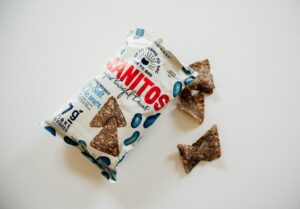
Chips, tortilla snacks, peanuts, pretzels—snacks are the most challenging product category for scales: they break. Every edge along the product path causes breakage, and breakage means complaints from retailers. The Multi-head scale Resolves the trade-off between speed and gentleness: gentle vibration feeding in the scale head, combination weighing for accuracy, and up to 80 weighings per minute on the production line.
How many servings does each snack product contain?
| Product | Recommended People | Reason |
|---|---|---|
| Peanuts, cashews, mixed nuts | 10 to 14 | Free-flowing, high cycle rates possible |
| Chips, Tortillas | 10 to 12 | Large pieces need large bowls |
| pretzel sticks, crackers | 10 to 14 | Small, but prone to breakage if dropped from a height |
| Popcorn, extruded snacks | 10 to 14 | Very light; large volume despite its light weight |
Setting Up a Snack Weighing Line
The line consists of the bucket elevator, which gently lifts the product to the desired height, the distribution plate, and the multihead weigher at the top, with the Vertical filling and capping machine. The distribution plate feeds the product radially into the heads—rotating slowly in the case of snacks to keep breakage to a minimum.
Each head contains a load cell pan. The control system reads all the weights, selects the combination of three to five pans that comes closest to the target fill weight, and empties precisely those pans into the fill chute. This is the reason for the accuracy: Not a single scale has to be exactly right; instead, the calculation selects the best total from many partial weights—typically ±0.5 g for snack fill weights ranging from 30 to 500 g.
Product Protection: Five Strategies to Prevent Breakage
- Limiting drop heights: Every edge, every pipe, and every change in elevation breaks up the snacks. A bucket elevator instead of free-fall conveying, short downspouts, and curved transitions are the foundation.
- Vibration Conveying Instead of Shaking: For snacks, the linear conveyors leading to the weighing head operate at a reduced amplitude—slower feed rate, less impact load.
- Shell Coating: Scale pans with a nonstick coating or polished surfaces protect delicate surfaces and prevent seasoned snacks from sticking.
- Gentle Emptying: Flap-type trays open gently; for chips, some systems use a deceleration cone to reduce the drop height.
- Spice application before weighing: Oil and spice mixtures make snacks slippery and leave grease on the trays—this task should be performed before the conveyor line, with cleaning intervals for the product path.
Connection to the packaging machine
The scale releases the batch once the form-fill-seal machine has finished forming the pouch—synchronization controls the cycle timing. For high-volume snacks (chips), the filling chute cross-section is the limiting factor: The product must pass through in a single stroke; otherwise, it spills over the sealing jaws and ends up in the cross seam. Stick pack lines for single-serving portions use the same weigher with a distribution grid to feed multiple filling tubes—resulting in 4 to 10 sticks per cycle.
Real-World Data: What Makes a Snack Line Stand Out
- Cycle rate: 50 to 80 weighings per minute with 10 to 14 heads; for chips, typically closer to 50 to 60 due to the volume
- Accuracy: ±0.5 g for fill weights between 100 and 300 g; ±1 g for very light portions under 50 g
- Cleaning: Spicy snacks leave grease in the product path—daily cleaning is standard practice, but CIP-capable scales reduce the cleaning time to just minutes
- Slide: Snacks need protection from oxygen and light; flushing with N₂ is standard practice for fatty products to prevent rancidity
When a multi-head scale isn't the right choice for snacks
For small production runs of fewer than 20 bags per minute, the investment isn’t worth it—a linear scale or a combination dosing system is sufficient. For highly crumbly, sticky snack products (e.g., caramelized nuts), special coatings and heated transfer points are required—this costs more than a standard scale and should be clarified before placing an order. And for fine crumbs (e.g., the seasoning on potato chips itself), a screw or belt feeder is the better solution.
Frequently Asked Questions
How many weighings does a multihead weigher perform when weighing chips?
Industry standard: 50 to 60 weighings per minute—the large bulk volume of potato chips limits the speed more than the weighing technology does. Nuts and extruded snacks reach 70 to 80 weighings per minute.
How accurate is the combined weighing process for snacks?
±0.5 g for fill weights ranging from 100 to 300 g is standard. Accuracy increases with the number of filling heads because the control system can choose from more partial weights.
Can a scale weigh nuts and chips one after the other?
Yes—the change is a recipe change. It’s just that cleaning between batches takes time: Spice residue from potato chips must be completely removed before adding nuts, otherwise the labeling won’t be accurate.
Does the scale require nitrogen flushing?
The packaging machine, not the scale, handles the gas flushing—it flushes the formed pouch before sealing it. For greasy snacks, this is standard practice to prevent rancidity; for nuts with no oil content, it is not necessary.
Related pages: What is a multihead weigher? | What is a vertical form-fill-seal (VFFS) machine? | Snack Packaging Machine | Potato Chip Packaging Machine
Request technical specifications and a quote for your production line. Please specify the product, bag size, and target output (bags/min.) – Request Technical Specifications and a Quote.



 English
  German